Examine This Report on Stages Of Team Or Group Development – Challenge Applications
: The auto mechanics of intergroup communication, decision-making, and responsibility are concurred upon and took care of efficiently. Almost all groups do not have several of these standards at some time in their period. Team development aims to meet these standards with continuous reflection and also development. Like any kind of form of advancement, it requires time as well as commitment to be effective.
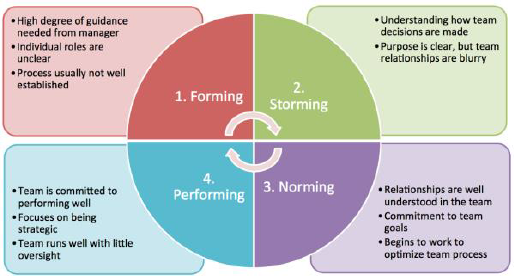
As the genuine work kicks in, the task might offer both technical as well as social challenges. Private job behaviors, leadership choices, or gaps in interaction can create tension within a group. Nuisance, disappointment, and anxiety generally emerge in reaction. This phase of team development is known as storming. Storming is one of the most challenging as well as ineffective of the 5 phases of development, but it is nonetheless essential to the team development procedure.
With this information, the team can begin desiring a far better team dynamic. The norming stage of team development is the tranquility after the storm. In this phase of team development, employee come under a rhythm as a cohesive taskforce. The abilities of each participant are validated and also used to execute the essential jobs.
3 Easy Facts About 3.2 Implications Of The Team Development Model – How Teams … Described
The team can deal with dispute as well as wage the task effectively. Some teams reach a stage of growth in which they grow at their private as well as collective jobs. The abilities of each participant are fully maximized, guidance is almost never needed, and participants feel a strong sense of trust fund in each other.
Reaching the executing stage is a major success and also often speeds up some form of team learning. Team learning is a behavioral procedure of looking for, gathering, reviewing, as well as implementing methods of group success. Whether through training, group initiative, or innovative leadership, team learning is an action step that guarantees healthy team development.
Knowing Outcomes Explain the 5 stages of team development. Explain how group standards and cohesiveness affect efficiency. Introduction Our discussion until now has actually concentrated primarily on a group as an entity, out the people inside the team. This resembles describing a vehicle by its model and also shade without considering what is under the hood.
5 Easy Facts About Stages Of Team Development Described
In teams, the interior features are individuals in the team as well as just how they connect with each various other. For teams to be effective, the people in the team need to have the ability to interact to add jointly to team results. This does not occur immediately: it creates as the team works together.
Phases of Team Development This procedure of finding out to collaborate successfully is called team development. Study has actually revealed that teams experience definitive phases throughout growth. Bruce Tuckman, an educational psychologist, determined a five-stage advancement procedure that the majority of teams comply with to end up being high performing. He called the phases: creating, storming, norming, doing, as well as adjourning. employee engagement.
Many high-performing teams experience five stages of team development. Creating phase The developing phase involves a period of orientation and also obtaining acquainted. Uncertainty is high throughout this stage, as well as people are trying to find leadership as well as authority. artificial intelligence. A member who insists authority or is well-informed may be wanted to take control.
Are Ultimate Guide To Team Building Activities That Don`t Suck services worth it?
Group efficiency enhances during this stage as participants learn to comply and also begin to concentrate on team goals. However, the consistency is precarious, as well as if disputes reappear the group can glide back into storming. In the performing phase, agreement and also collaboration have been reputable as well as the team is fully grown, organized, and also well-functioning.
Trust: a behavior your team needs to succeed
Troubles as well as disputes still arise, however they are dealt with constructively. (We will talk about the function of dispute and problem resolution in the following area). The team is focused on problem fixing as well as satisfying group objectives. In the adjourning phase, a lot of the team`s objectives have actually been achieved. The focus gets on concluding last tasks as well as documenting the initiative and also outcomes.
There may be regret as the team finishes, so a ceremonial acknowledgement of the work and also success of the team can be useful. If the team is a standing board with ongoing obligation, participants might be changed by brand-new individuals and also the group can go back to a creating or storming stage as well as repeat the advancement process.
5 Stages Of Team Development: Tuckman`s Group Development for Dummies?
Team standards established a standard for actions, attitude, and also efficiency that all staff member are anticipated to adhere to. Norms are like policies yet they are not jotted down. Rather, all the staff member unconditionally understand them. Standards work since employee wish to support the team and also preserve partnerships in the team, and when norms are breached, there is peer pressure or permissions to apply conformity.
 The Definitive Guide for Why Is Team Development Important To A Leader? – Cmo …
Originally, during the creating and also storming stages, norms concentrate on expectations for attendance and also commitment. Later, during the norming as well as executing phases, norms concentrate on connections and degrees of performance. Efficiency norms are really vital since they specify the degree of work initiative as well as standards that establish the success of the group.
Standards are just efficient in managing actions when they are approved by employee. The level of on the group primarily establishes whether team participants approve as well as adjust to standards. Group cohesiveness is the degree that participants are brought in to the group as well as are motivated to remain in the group. platform.
Some Known Facts About 8. Progress Through The Stages Of Team Development.?
They attempt to conform to standards due to the fact that they wish to preserve their relationships in the team and also they intend to meet team expectations. Groups with solid efficiency standards and also high cohesiveness are high doing. For example, the seven-member exec team at Whole Foods hangs around together beyond work. Its participants frequently interact socially and also also take group getaways.
You don`t need to get superpowers from a product or create one of one of the most renowned brands of your generation to be a wonderful leader. Guide your team through each stage of the procedure with the following pointers:1. Set a clear objective and mission as well as revisit it throughout the process.
It is the structure that will help you choose. It provides you instructions. Without it, you`ll go nowhere. Individuals get so lost in a particular job that they neglect why they are doing it in the very first location. It is easy to forget the “big image”. Groups require a clear purpose and also objective as well as should be reminded of them often.
More About Stages Of Team Development
Set guideline as well as ensure they are followed. Regulations might not appear fun, however they improve complication. Without them, no person will recognize what is considered acceptable habits. Every person will certainly have their own “style” of doing things. Teams without regulations are disjointed, susceptible to problem and ineffective. Among the very first tasks that teams must do is establish guideline.
Some examples are:turnkeycoachingsolutions.com Do not disrupt an additional participant when they are talking. Transform off your phone throughout working conferences. Track your time transparently with Toggl Track. Produce a regular work strategy with jobs and share it with the group. Bear in mind that guidelines are created to aid your group remain concentrated on what issues mostperformance.
The model of cohesive team behavior
Let other members serve as leaders or facilitators. Every group must have a facilitatora person that leads as well as overviews meetings and discussions. Someone that drives the group towards a common goal. As a business founder or manager, you may be the marked team leader. Yet, that doesn`t suggest you ought to constantly be the one leading.